
Five pillars, one coherent framework
The Ministry discussion proposal (version 1.1, 17 October 2026) describes five connected pillars: environmental education; ongoing stewardship programs; defined school projects; measurement and recognition; and carbon-impact assessment with possible future carbon finance. The fifth pillar is explicitly conditional.
Environmental Education
Practical knowledge of climate change, conservation, waste, water and energy.
Stewardship Programs
Ongoing environmental themes managed by school clubs and teacher coordinators.
School-Based Projects
Specific student-led activities with plans, responsibilities and measurable results.
Measurement & Recognition
Document evidence, assess results, report digitally and recognise schools through Envirolympics.
Carbon-Impact Assessment & Potential Carbon Finance
Where appropriate, estimate climate impact; separately explore eligibility for verified credits.
How school programs fit the framework
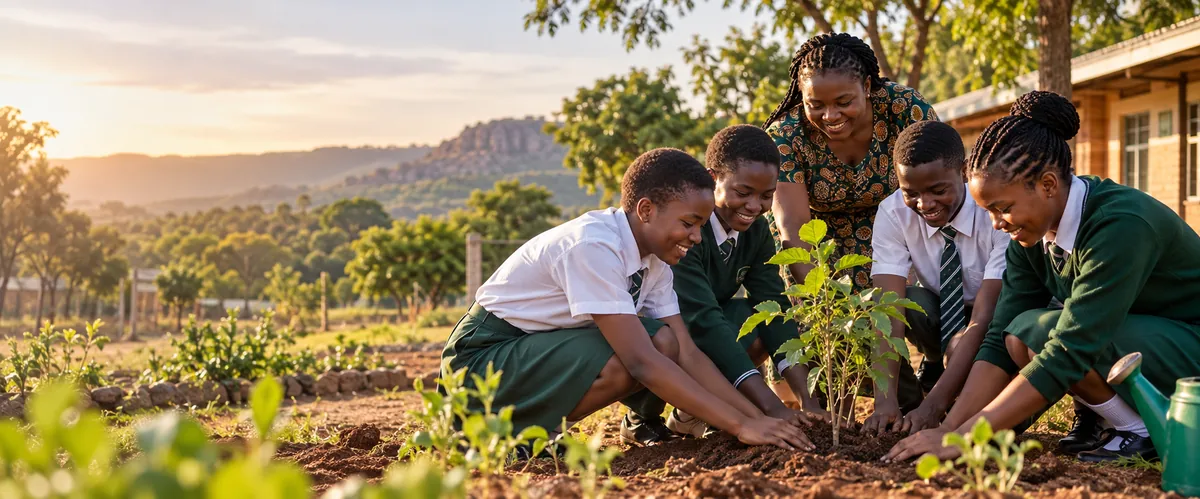
The seven school program areas are not additional pillars. They are practical environmental themes through which schools can implement the five-pillar framework. For example, tree planting can involve environmental education, eco-club stewardship, a supervised reforestation project, tree survival measurements and—only where justified—a subsequent carbon-impact estimate.
Educational points are not carbon credits
A school’s verified participation, award points and environmental activity records are useful for learning and recognition. They do not automatically produce verified, tradeable carbon credits. Any carbon-market route would need independent scientific, legal and methodological assessment. Learn how carbon accounting is treated.
Programs are not the same as projects
A program is an ongoing area of environmental responsibility such as Water Stewardship. A project is a defined activity with objectives, a plan, safeguards and measurable evidence—for example, repairing a tap through responsible staff, tracking water use or demonstrating efficient irrigation.
Schools choose locally relevant activities; a possible first-year pilot school could start with two or three of the seven programs.